What the Headstones Say: A Slow Wander Through St James Churchyard
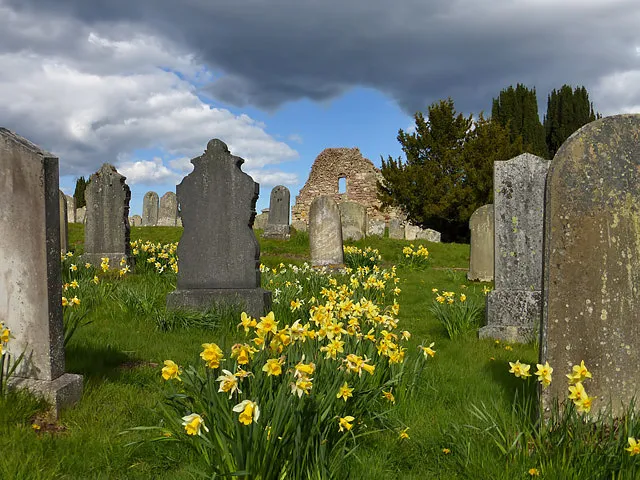
Photo: Walter Baxter , CC BY-SA 2.0, via Wikimedia Commons
The first thing to say about St James churchyard is that it is not a museum. It is a working part of the parish. People are buried here, families visit, services take place, and the grass is cut by someone who has a schedule. That matters for how you walk through it. A churchyard rewards curiosity, but only if the curiosity is quiet.
With that in mind, this is a guide to a slow look rather than a quick tour. It is for anyone who has walked past the gate a hundred times and wondered about the stones inside, or who has come to Iron Acton for the day and wants to understand the village through its oldest surviving script. You do not need a degree in local history. You need twenty minutes, a pair of shoes that can cope with uneven ground, and the willingness to stand still.
Start with the building, not the stones
Before you read a single headstone, look at the church. The tower, the walls, the windows and the roof tell you what kind of place this has been: a farming parish, a place with gentry nearby, a community that has rebuilt and repaired as money and fashion allowed. The churchyard wraps around that story. Paths lead you in certain directions. The oldest stones are often not where you expect. The ground itself rises and falls with years of use.
Take a moment by the gate. Notice which way the paths run. Notice where the ground is soft. Notice the trees, especially any yew. Then walk in slowly. The first minute is not for reading. It is for settling your eyes.
How to read a headstone without guessing
Most headstones follow a pattern. Start at the top. You will usually find a name, then a date of death, then an age. Below that there may be a relationship: wife of, husband of, son of, daughter of. Then a line of verse or a short inscription. The style of the lettering changes over time. Earlier stones often have tighter, more formal script. Victorian stones can be fussier, with carved borders and symbols. Twentieth-century stones tend to be plainer.
Read the words as they are, not as you expect them to be. An age can be given in years, months and days. A woman may be described as a relict, meaning widow, or a consort, meaning spouse. A child may be called an infant even if they lived for several years. A date may look wrong because the stone has eroded, or because the carver made a mistake, or because the calendar changed long before the stone was cut. If something does not make sense, write it down and check it later rather than inventing a story on the spot.
Symbols: clues, not codes
Stones from the eighteenth and nineteenth centuries are full of symbols. A willow tree often suggests mourning and the fragility of life. An urn can point to the body as a vessel and the soul as something released. Clasped hands usually speak of parting or reunion. An anchor suggests hope. A lily suggests purity. A broken column, popular in the Victorian period, marks a life cut short. Ivy stands for fidelity and memory.
These are clues, not a secret code. The same symbol can mean slightly different things in different places and at different times. A good rule is to ask what the symbol adds to the inscription rather than what it proves. If a stone has a willow and a line about being cut down like a flower, the meaning is fairly clear. If it has an anchor and no text, you can note it and move on. You do not have to solve every stone.
Stone, lichen and the honesty of weathering
Look closely at the surface. Limestone and sandstone weather differently. Marble can stay bright but stain and erode. Slate holds lettering well. Lichen grows slowly, and a stone covered in it has been in place for a long time. None of this gives you an exact date, but it gives you a sense of age and exposure.
Do not chalk, scrub, scrape or press hard on a stone to make it readable. Do not take rubbings without permission. Old stone is softer than it looks, and the damage is permanent. If you want to record an inscription, use a notebook and a pencil, take a photograph from a respectful angle, and leave the stone exactly as you found it.
Family stories in the margins
A churchyard is a map of a village's households. You may find clusters of the same surname, suggesting a family that stayed for generations. You may find stones for people who died young, or women who outlived several husbands, or men described by a trade. You may find a stone that mentions a place outside Iron Acton, which tells you that someone moved here, or moved away, or married into the parish.
Iron Acton's past is tied to farming, to the lanes and fields around the village, and to the gentry families associated with Acton Court. The churchyard will not give you the whole story in one visit, but it will show you the ordinary families who made the parish work. Look for the smaller stones at the edges. Look for the stones that have been repaired. Look for the ones that are almost illegible and wonder who decided to keep them standing.
If you find a Commonwealth War Graves stone, treat it with particular care. It is a grave, not a monument, and it may still be visited by family.
Churchyard etiquette for curious visitors
Walk on the paths where you can. Do not step over a grave if there is a way around. Keep dogs on a lead unless the church has said otherwise. Do not picnic on graves, lean on headstones, move flowers or take anything away. If a service or a funeral is taking place, leave quietly and come back another time. If you want to photograph people, ask first. If you want to photograph a stone, check that you are not in someone's way.
This is an active churchyard, not a heritage attraction with a ticket desk. The best visitors are the ones who behave as if they have been invited, because in a sense they have.
A short slow circuit
Give yourself half an hour. Enter by the main gate and walk the perimeter first, without stopping. Then choose one section and read three stones properly. Look at the lettering, the symbols and the age. Stand back and see how the stone sits in the ground. Then move to another section and do the same. Finish near the church door, where the older stones often cluster, and sit for a minute if there is a bench.
You will not remember every name. You are not meant to. The point is to notice that the village has been lived in by people who left marks, and that those marks are still here, weathering quietly in the same rain that falls on the lanes. In 2026, that is a useful thing to remember.