Twenty's Plenty? Speed, School Runs and the Edges of Iron Acton
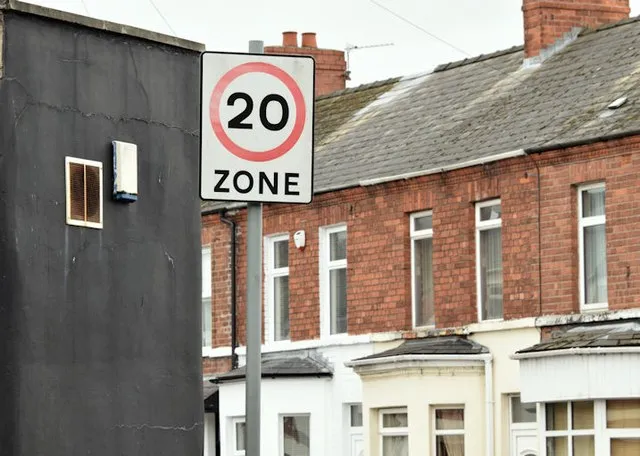
Photo: Albert Bridge , CC BY-SA 2.0, via Wikimedia Commons
Ask anyone in the village what they would change and the answer usually arrives within about four seconds: the traffic. Not the volume, necessarily — the speed. The car that comes through the narrow bit at a pace that suggests the driver has not noticed the narrow bit. The one that overtakes a cyclist on a blind bend. The one doing well over thirty past the school gate at ten to nine, with a child on the pavement and a hedge on the other side.
So: 20mph. Would it work? Honest answer: partly, and only if we are clear about what we are asking for.
The case for it is straightforward
Lower speeds mean shorter stopping distances and less severe injuries. That is not really up for debate. A pedestrian hit at 30mph is far more likely to be killed than one hit at 20mph, and no amount of careful driving changes the physics. Add the fact that much of Iron Acton's road network was never designed with pedestrian refuge in mind — no footway on the approach lanes, high hedges, bends that hide the very thing you need to see — and the argument for slowing everything down feels obvious.
There is precedent, too. Wales introduced a default 20mph limit on residential and restricted roads in September 2023, with some routes since reverting to 30 where the evidence supported it. In England there is no national default; councils set limits case by case through Traffic Regulation Orders, and South Gloucestershire has been rolling 20mph zones out across a number of parishes for years. Drivers are getting used to the idea. It is no longer an eccentric proposal.
The awkward bits
Here is where the campaign slogans start to fray.
A sign is not a speed limit. It is a statement of intent. Studies of 20mph schemes consistently find that average speeds fall by a modest amount — a couple of miles an hour — and that the reduction is largest where the limit is self-enforcing because the road already feels slow. Where the road is wide, straight and open, drivers revert to whatever feels comfortable, whatever the roundel says.
Enforcement is finite. Avon and Somerset Police cannot park a van on every approach lane; they have to prioritise. Community Speedwatch can gather data and raise awareness, but it cannot issue penalties. Any scheme that depends on enforcement rather than design is asking for a level of policing that does not exist.
The approach lanes are not residential streets. A 20mph limit through the built-up core is one thing. Applying it half a mile out along a hedge-lined lane with no houses, no footway and a working farm at the end is where the argument gets thinner and the sign clutter thicker. Blanket limits invite the sort of quiet non-compliance that undermines the ones that matter.
And it costs real money. A Traffic Regulation Order, consultation, the legal notices, the posts, the plates — several thousand pounds before anyone has slowed down at all. That money has to come from somewhere, and it competes with drainage, footways and everything else.
What actually changes behaviour
If we are serious about speed rather than about being seen to do something, the evidence points to the physical stuff.
Gateway features at the village edge — narrowing, a change of surface, a raised table, something that tells the driver at a glance that this is a different kind of place. Sight lines managed so that a bend reads as a bend. Verge and hedge maintenance, because half our speeding problem is really a visibility problem. Passing places done properly on the lanes that need them. And yes, fewer painted centre lines, which sounds counter-intuitive until you see how much they encourage people to treat a country lane as a two-lane road.
None of that is glamorous. All of it works better than a plate on a pole. All of it costs more than a plate on a pole.
The school-run corner
If there is one place where the argument stops being abstract, it is the school gate at ten to nine.
The problem there is not really the limit. It is a cluster of things at once: cars parking on both sides where the road is only just wide enough for one, three-point turns in the middle of the traffic, children stepping out between vehicles, and drivers who have done the same manoeuvre every morning for four years and have stopped seeing it. A 20mph sign does not fix a turning circle. A properly managed drop-off, a bit of informal one-way discipline and some honest conversation about how far we are each willing to walk would probably do more good than anything the council could install.
So where does that leave us?
Here is a position I can defend.
Twenty is right in the core of the village and right outside the school, and it should be there permanently, not as a token but as a designed street. Narrowed junctions, a raised crossing point, verges and hedges cut back so you can actually see the child before they step out.
On the rural approaches, be honest: a 20mph sign halfway to the next parish is a wish, not a limit. What those lanes need is engineering — passing places, sight lines, a surface that does not invite 45 — and a proper conversation about which vehicles actually have business there, including the rat-run traffic that treats the parish as a shortcut between the larger settlements either side.
And a wider point. Speed limits are cheap to promise and expensive to make real. If we campaign for a number, we will get a number. If we campaign for streets that feel slow, we might get streets that are slow. The second one is harder, slower and considerably less photogenic — but it is the one that would actually change the walk to school.